Google DeepMind, Outfront Reimagine OOH Advertising As A Living Creative System Across NYC
Rogier Vijverberg, Co-Founder and CCO of SUPERHEROES, shows how Google DeepMind and Outfront’s NYC campaign treated out-of-home as a living system where constant change keeps people looking up.
Make brandbeat one of your go-to sources on Google

This campaign showed that out-of-home isn’t a static medium anymore. With creativity and technology, it can bring energy back into public space and make people look again.

Rogier Vijverberg
Out-of-home advertising only works when it gives people a reason to look twice. The moment creative stops changing, attention disappears. Google DeepMind and Outfront’s Imagine if… campaign was built around that reality, treating more than 4,000 screens across New York City not as repeated placements, but as a single, living canvas of constantly refreshed art. The result was a citywide experiment in variation at scale, proving that when OOH stays energetic and unpredictable, people don’t tune it out.
Rogier Vijverberg is the Co-Founder and Chief Creative Officer of SUPERHEROES, the agency behind the campaign and Ad Age’s 2025 Small Agency of the Year. His work sits at the intersection of brand, digital art, and emerging technology, including his role as Founder of the art collective JIMMY. For Vijverberg, Imagine if… serves as a proof point for where out-of-home can go next when it’s treated as a creative system rather than a static medium.
"This campaign showed that out-of-home isn’t a static medium anymore. With creativity and technology, it can bring energy back into public space and make people look again," says Vijverberg. That thinking directly addresses what he sees as a core weakness in traditional outdoor advertising.
The real ad blocker: Rather than fighting distraction, he believes out-of-home has to earn physical attention. "Your thumb is a very quick ad blocker, but your neck is a pretty potent ad blocker as well. When you use the same image everywhere, that's boring advertising," Vijverberg explains. "Once you've seen something, why would you pay attention to it again? You just look the other way."
Relentless refresh: The project was a "very close collaboration" between the Google DeepMind team, the out-of-home company Outfront, and SUPERHEROES. The Imagine if… campaign transformed thousands of digital screens into an ever-changing gallery of eight-second videos, culminating in a massive takeover on the giant screens of Times Square. "We created over 250 pieces of content, and every week the videos were refreshed based on inputs we got from New Yorkers. It’s become an amazing example of what the creative use of AI can mean for a medium like digital out-of-home."
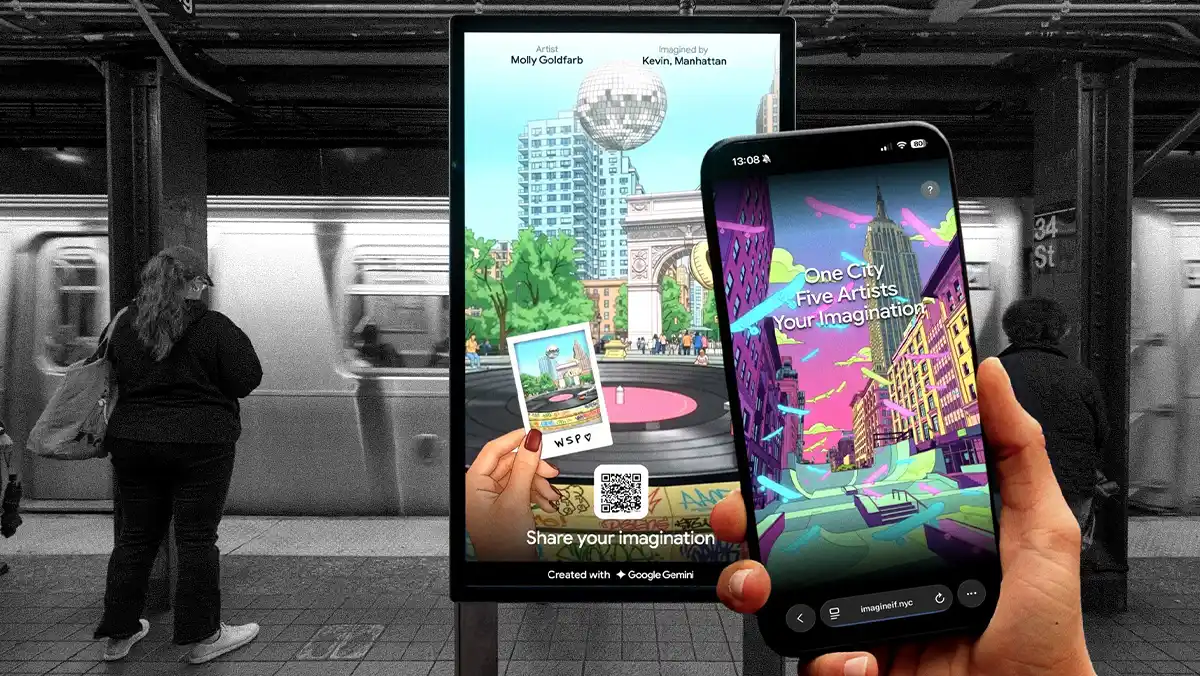
With AI often getting a bad rap, a key objective for Google was to shift perception by showing how the technology could actively empower creativity. The project invited five local artists, one from each of New York City’s five boroughs, to bring their visions of the city to life: Subway Doodle, Lauren Camera, Jeff Wave, Molly Goldfarb, and Ariana Cimino. Some had never used AI before. Their journey positions AI not as a replacement for artistic intent, but as a new medium that introduces friction, experimentation, and, ultimately, creative expansion.
Wrestling the machine: "Working with AI can be like a wrestling match with the machine. You have an idea you want to visualize, but you never really know what's going to come out. Ultimately, our artists learned to control the AI to better reflect their creative vision. They grew so much in the process, and all of them want to continue exploring the technology," says Vijverberg.
An interactive loop, enabled by Outfront's QR code system, allowed public imagination to directly fuel this artistic creation. Passersby could scan a code on the screen, which took them to a mobile site that allowed them to view the existing art and generate their own AI visions of NYC on the spot. This model connects OOH to the larger trend where the creator economy meets billboards.
A two-way street: In an industry seeking ways of winning in a digitally drained world, this approach offers one potential path forward. "It was really important for Outfront to showcase that out-of-home can be used to engage audiences in fresh ways. The back-and-forth mechanism we created with QR codes, bringing public input back into the creative, really showcased the interactive power of the medium."
But the campaign's true success was measured on the street. The sheer diversity of the creative allowed the mass-media broadcast to feel like a series of personal discoveries, making a strong case that when OOH stays energetic, it can become a medium people actively follow. "I've had people I met at random tell me they were following the campaign, and what was amazing is that everybody called out something different they had seen," Vijverberg concludes.