StreetEasy Turns OOH Subway Presence Into Measurable Marketplace Momentum
Bridget Sullivan, Director of Integrated Marketing at StreetEasy, and Creative Directors Sam McCluskey and Tom Hall of Mother explain how sustained NYC subway dominance.
Make brandbeat one of your go-to sources on Google

To reach New Yorkers and feel embedded in the fabric of this city, you have to show up in the spaces where they live, commute, and spend their time.

Bridget Sullivan
StreetEasy is treating out-of-home as urban infrastructure. In New York City, its latest campaign across subways and hand-painted murals is designed to live inside the daily commute, becoming part of the city’s operating rhythm. By buying for permanence and reach, the brand is turning sustained visibility into measurable marketplace momentum.
Bridget Sullivan, Director of Integrated Marketing at StreetEasy, oversees brand strategy and long-term media investment for the Zillow-owned marketplace, shaping how the company shows up across New York City. She leads the work in partnership with Creative Directors Sam McCluskey and Tom Hall at Mother, who guide the campaign’s creative system across transit and mural executions. Together, they are responsible not just for creative output, but for turning sustained media presence into a measurable component of StreetEasy’s marketplace performance. That philosophy is clearest in the brand’s high-frequency subway presence.
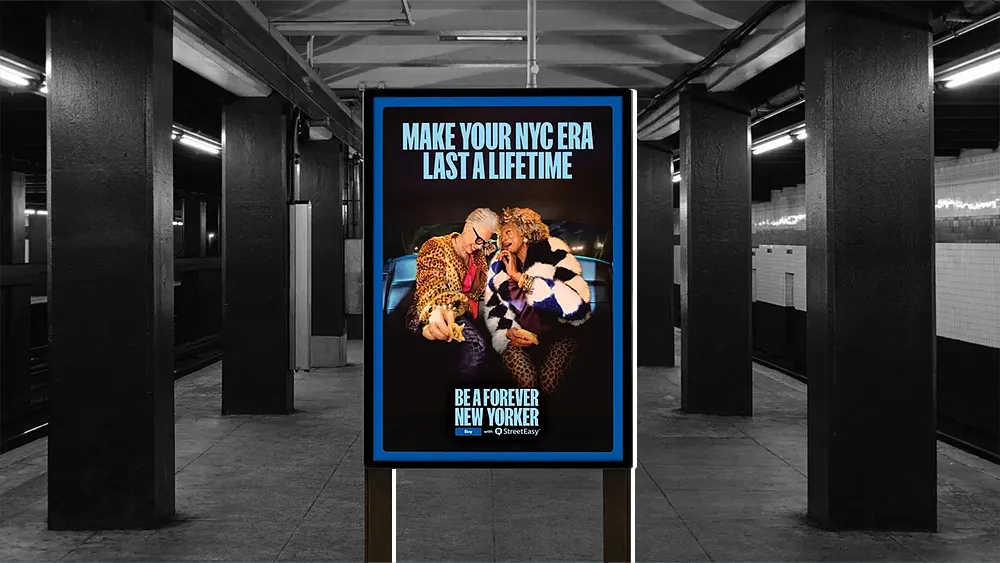
"To reach New Yorkers and feel embedded in the fabric of this city, you have to show up in the spaces where they live, commute, and spend their time," Sullivan says. "The subway is the connective tissue of the city. By maintaining a consistent presence there, we reinforce that we’re part of the everyday rhythm of New York." For StreetEasy, that means buying for consistency and coverage rather than bursts. Familiarity compounds over time, aligning the brand with the habitual movement patterns that precede housing decisions.
Word of mouth advertising: “Our work has become so recognizable that New Yorkers often call it ‘the subway campaign,’ and we’ve heard from anecdotes and social media posts that they’ve even come to look forward to it,” Sullivan says. For StreetEasy, that recognition reflects a deliberate strategy of consistency over novelty. The audience naming the work themselves signals the brand has secured a fixed position inside the commute.
Headlines in a hurry: In a saturated media market, presence alone isn’t enough. As McCluskey and Hall explain, headlines matter. "With transit placements, we're talking to New Yorkers in motion—commuters who have seconds to connect with the message. The creative needs to be direct and immediate." notes McCluskey. "Headlines like 'STAY PUT. STAY INTERESTING.' work because they're quick reads that land with attitude," Hall adds.
Beyond transit, the brand invests in hand-painted murals designed to signal permanence and care. Sullivan notes that the "detailed, realistic craftsmanship" signals "care, commitment, and longevity." For the mural's visual, the team selected a rooftop lounger basking in the sun, an image designed to stop people in their tracks and create a photo moment.
Precision before permanence: "We selected mural locations by combining StreetEasy data on the most-searched neighborhoods with foot traffic insights from our media agency, Canvas, to ensure we focused on areas with both high buyer interest and strong foot traffic," explains Sullivan. "We then layered in our own on-the-ground knowledge of the city to confirm the placements would feel intentional and culturally relevant." Large-format, hand-painted work only appears where housing demand signals and pedestrian density intersect, tying cultural visibility directly to search intent rather than symbolic neighborhood presence.
Playing the long game: But for all its cultural resonance, the campaign is ultimately judged on its business impact. "We use Marketing Mix Modeling, which allows us to isolate the long-term contribution of OOH to search behavior, site visits, and downstream engagement," Sullivan states. "This approach helps us understand the sustained lift it drives over time, not just immediate spikes." This discipline ties cultural presence directly to marketplace performance.
For StreetEasy, that strategy demands sustained presence in the spaces where housing consideration actually starts: on platforms, in stations, along neighborhood corridors. The media isn’t treated as backdrop but as part of the urban experience itself. “It’s important that the work adds to the streets it lives on," Sullivan concludes.