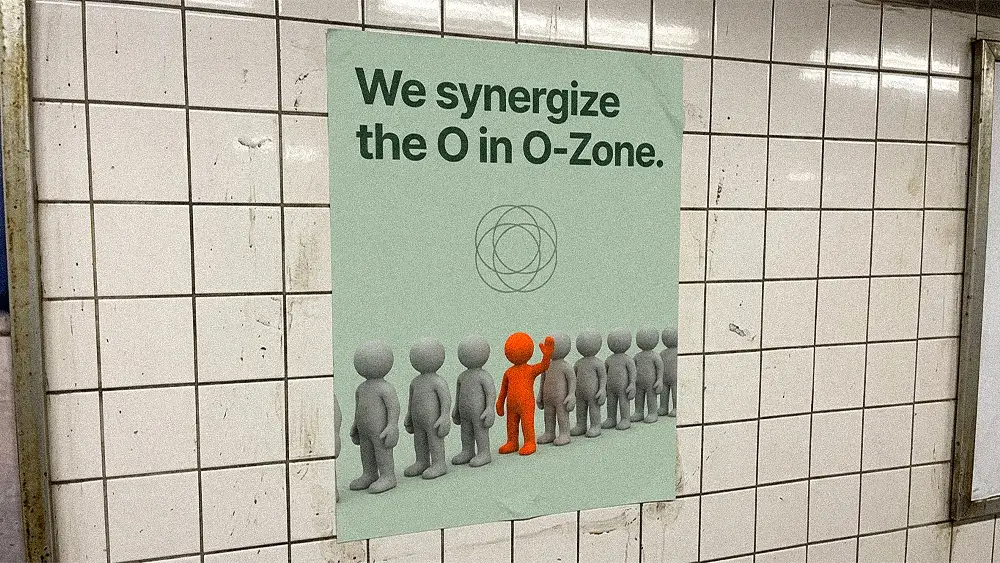
The most talked-about campaign of the week had no programmatic spend behind it. No influencer seeding, no paid social. A handful of out-of-home ads for a fake AI company called Goofstump, complete with a working website and a product suite of meaningless software names, generated national coverage within days and set an entire industry arguing about copy on a train.
The posters are the work of NYC comedian Harris Alterman, and the story was covered this week by State of Brand, which framed the stunt as an indictment of tech advertising's voice. The fake ads succeeded, the publication argued, because they were functionally indistinguishable from the real campaigns hanging next to them. Alterman didn't exaggerate the genre. He removed the product and let the category's own language do the rest.
That reading is fair. But there is a second story inside this one, and it cuts the other way: the stunt is also one of the strongest live demonstrations of out-of-home's power that the industry has seen in years.
The medium delivered. That's why the joke landed.
Consider the media math. A comedian bought a small number of static placements in a physical space and got more earned conversation than most eight-figure digital campaigns manage. No targeting, no retargeting, no algorithm. Just posters in front of millions of riders with nothing else to look at.
For the parody to work at all, the audience had to know the source material cold. Riders recognized a pitch-perfect imitation of the AI category's voice on sight, which means they had been reading the real ads closely all along. State of Brand notes that tech's share of New York transit advertising jumped 50 percent in the first quarter and now accounts for roughly 15 percent of the system's inventory. Months of that exposure produced an audience fluent enough in the category to laugh at a fake version of it. Digital channels rarely produce message penetration that deep.
The same is true of the broader pattern State of Brand documents. Riders defaced Friend's eleven-thousand-card takeover within days of launch. Sticker campaigns have tracked AI ads across the system since the fall. A subvertising artist hit the London Underground with counterfeit OpenAI posters last month. Each incident tends to get framed as hostility toward transit advertising. It can just as easily be read as proof that people physically engage with this channel in a way no banner ad has ever provoked. They write on it. They photograph it. They parody it. The subway, as the original piece puts it, has become a feedback channel.
When attention is guaranteed, copy is the competition
Here is where the two readings converge. If the medium reliably delivers eyes, and this week showed it delivers them with unusual intensity, then reach is no longer the variable separating winners from wallpaper. The words are.
That is the part of the State of Brand piece worth taping to the wall of every creative review. AI transit advertising has converged on a single voice: lowercase wordmarks, generous white space, abstraction stacked on abstraction, copy written for the few thousand buyers in the category and inflicted on a few million commuters. When a satirist can replicate that voice by stringing corporate nouns together, the category has handed its differentiation away. Riders now have a name for the mental folder where all of those ads live, and the name is Goofstump.
The opportunity sits right there. The first AI brand to break from the uniform doesn't need a bigger buy. It needs a sentence a tired person on the F train can parse in four seconds. In a car where half the ads now risk being mistaken for jokes, plain language is no longer table stakes. It is the contrarian creative position, and it is wide open.
Double down on the channel, rebuild the message
The wrong lesson from Goofstump would be to retreat from transit because a comedian made fun of the category. The medium just made a fake company famous in a week. A real company with copy worth reading inherits all of that same attention.
The right lesson is to treat creative the way the channel deserves. The tools exist to know whether a tagline lands with a general audience before it prints: comprehension testing, message recall, resonance scoring against actual riders rather than category insiders. OOH hands a brand the audience. Whether that audience walks away with a message or a punchline is decided in the work.
The Goofstump ads will come down eventually. What they leave behind is a cleaner brief than the industry has had in years. The medium is not the question. The words are.