How Jeep Built A Comedy-Led Platform To Stand Out In Family Vehicle Marketing
Olivier Francois, Global Chief Marketing Officer of Stellantis and CEO of FIAT, and Bob Broderdorf, CEO of Jeep, are scaling a comedy-led strategy to differentiate in a crowded category.
Make brandbeat one of your go-to sources on Google

When you find chemistry between a vehicle, a brand, and a person, you don’t just move on. You build on it.
Olivier Francois
The category playbook for three-row SUVs is well established: lead with space, layer in comfort, and reinforce the feature set. The result is often effective, but rarely memorable. For Stellantis, the challenge with the Jeep Grand Wagoneer was to reach family buyers without slipping into that familiar, minivan-adjacent territory. Rather than follow the standard formula, the brand made a deliberate shift toward entertainment-led creative through a partnership with comedian Iliza Shlesinger. The campaign reframes product messaging through storytelling, supporting a broader effort to reposition the vehicle while proving that attention and recall don’t have to be trade-offs.
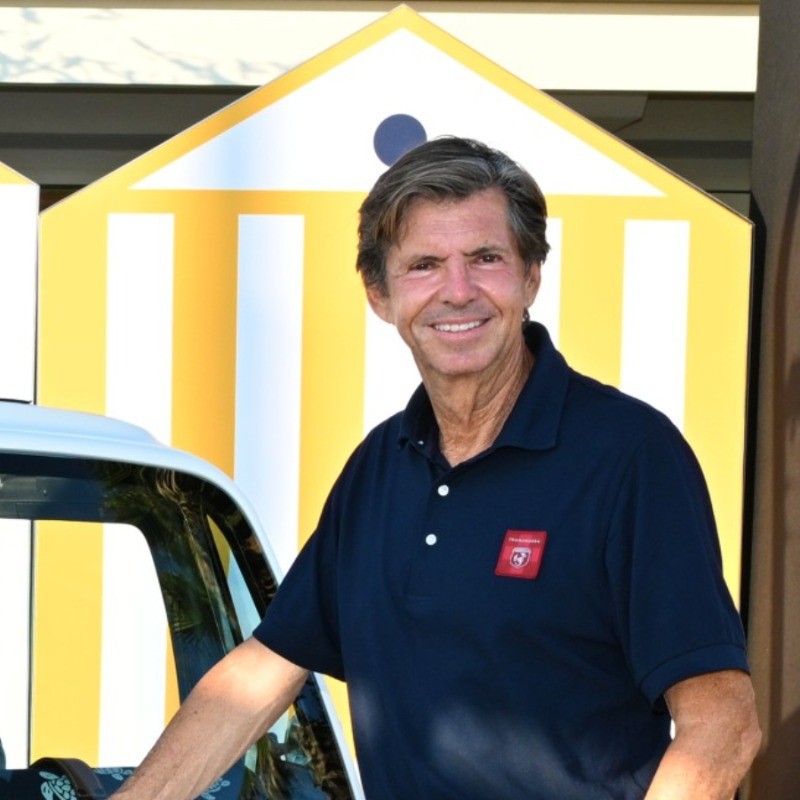
Rather than refresh the idea, Jeep made the less common decision to scale it. Strong performance metrics and early dealer enthusiasm gave the team confidence to double down on Shlesinger’s comedic voice instead of moving on to a new concept. The effort is led by Olivier Francois, Global Chief Marketing Officer of Stellantis and CEO of FIAT, alongside Bob Broderdorf, Chief Executive Officer of Jeep, with Shlesinger fronting the campaign as a tongue-in-cheek "Chief Family Officer." Pairing distinctive creative with high-visibility media, the team backed an unconventional idea and supported it at scale. The result is a platform where humor carries traditionally dry product details without losing audience engagement.
"When you find chemistry between a vehicle, a brand, and a person, you don’t just move on, you build on it," says Francois. Getting leaders comfortable with a comedic spot that strays from Jeep’s rugged heritage required top-down buy-in. Broderdorf framed the move as part of an effort to make the brand willing to have fun and take creative risks. "You don’t get something like this done without courage," he adds. "Most ideas like this never make it out of a cubicle because people won’t take the chance."
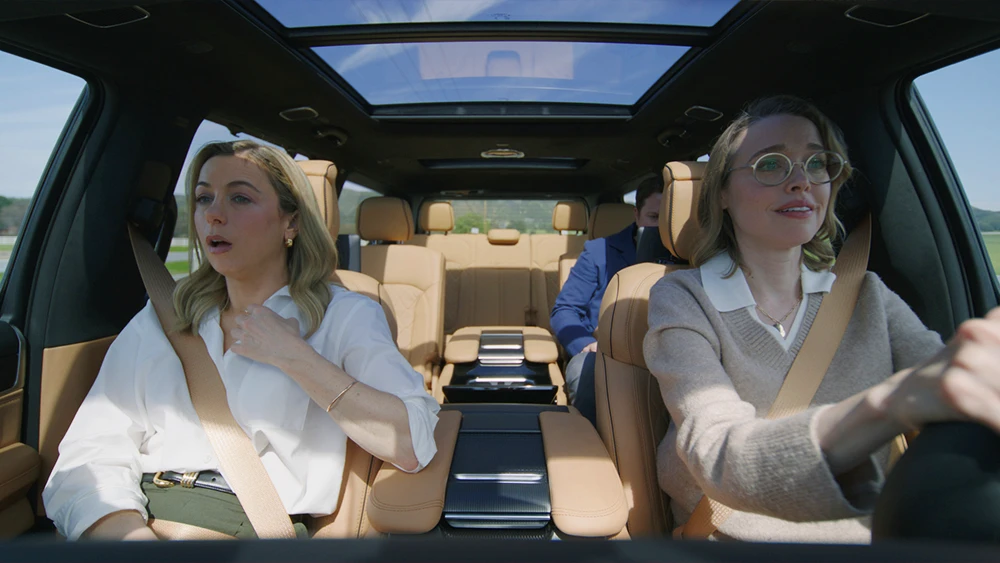
Features with flavor: Casting Shlesinger offered a way to weave automotive specs into relatable entertainment, reinforcing brand trust and authenticity with everyday buyers. In the original commercial, she plays a glamorous executive who delivers details about towing capacity, price, and cargo space while mocking familiar SUV clichés. "No woman wants to drive a minivan if they don't have to," Shlesinger says, rattling off specs like the Palermo leather and 27.4 cubic feet of trunk space. "If you can get the information out in a spoonful of sugar, then you've done your job," she adds, noting that comedy acts as the ultimate delivery mechanism for vehicle features.
From bit to buy: Rather than invent a new premise for the sequel, Stellantis dropped Shlesinger into a Jeep dealership with customers and test drives. The first ad introduced a way to speak about the vehicle. The follow-up puts that tone into a place where shoppers make decisions. "When the proposal came in of actually sort of turning Iliza loose at an actual dealership, it just seemed so funny we had to do it," Broderdorf says. For Shlesinger, the comedic mission remained the same. "At the end you're like, maybe I do need a Grand Wagoneer. Maybe I do need massage seating and a heated steering wheel."
A lane of its own: Francois is deliberate about keeping the Wagoneer campaign distinct from other Jeep creative, ensuring it maintains its own tone and identity. The goal was to create something that still feels true to the brand and carve out a voice that resonates specifically with family buyers without slipping into familiar territory. "In this category, everybody says the same thing: luxury, space, comfort, technology, family," he says. "Iliza brought humor, edge, and personality, and the whole thing immediately felt fresh."
In this model, humor acts as the connective layer between upper-funnel attention and lower-funnel conversion. Jeep pairs broad national visibility with more targeted digital efforts, using high-reach placements to drive awareness while refining audience targeting downstream. The campaign is anchored in a major media push around NCAA March Madness, with phase two extending across tournament games and into April and May. That scale creates a foundation for more precise engagement, particularly with priority audiences. "We can target women very specifically, obviously, with digital today," Broderdorf explains.
What this campaign illustrates is a shift in how brands think about creative. Instead of cycling through ideas, Stellantis treats this as a system to scale, backing it with measurement tools like Ace Metrix to ensure it delivers on both attention and recall. In a category where messaging often blends together, that combination makes creative work harder and stand out longer. "The challenge was to speak about family without making it feel like a minivan and to give the Grand Wagoneer a real voice and personality," Francois concludes. "The first campaign had both strong attention and strong memorization, that’s what defines a truly effective campaign."