Newell Brands Shrinks Its Portfolio, Uses Real World Behavior Signals To Guide Innovation
Kris Malkoski, CEO of Learning & Development at Newell Brands, explains how observing the way people use surfaces, spaces, and everyday objects drives product innovation across a portfolio that includes EXPO, Sharpie, and Elmer's.
Make brandbeat one of your go-to sources on Google

It always starts with the unarticulated unmet consumer needs. People cannot tell you what they are missing or how they want to evolve their experiences in the home or at work, but if you watch them, you see compensating behaviors.

Kris Malkoski
Newell Brands has spent the past three years doing something most consumer goods companies talk about but rarely execute: aggressively shrinking its portfolio to sharpen its innovation focus. The company cut its brand count from 80 to roughly 50, concentrated investment on 25 hero brands that represent 90 percent of net sales, and entered 2026 with what leadership has called its strongest innovation pipeline since acquiring Jarden a decade ago. It's a case study in strategic restraint as a growth lever, and it raises a straightforward strategic question: once you've decided which brands to bet on, how do you decide what those brands should build?
For Kris Malkoski, CEO of Newell Brands' Learning & Development segment—a $4.4 billion portfolio and 17,000 employees across household names like EXPO, Sharpie, and Elmer's—the answer is deceptively simple. Don't ask consumers what they want. Watch what they're already doing in the physical spaces where they live and work, and design products that eliminate the friction they've learned to tolerate. It's an approach that parallels a broader shift across marketing and media toward behavioral insights drawn from how people move through and interact with physical environments. A veteran of Procter & Gamble who helped build retail staples like Aleve and ThermaCare, Malkoski applies a "jobs to be done" framework that treats real-world behavioral observation as the primary innovation input. Instead of fielding surveys that yield noise, her team looks for the clumsy workarounds people invent when no product exists to solve their problem.
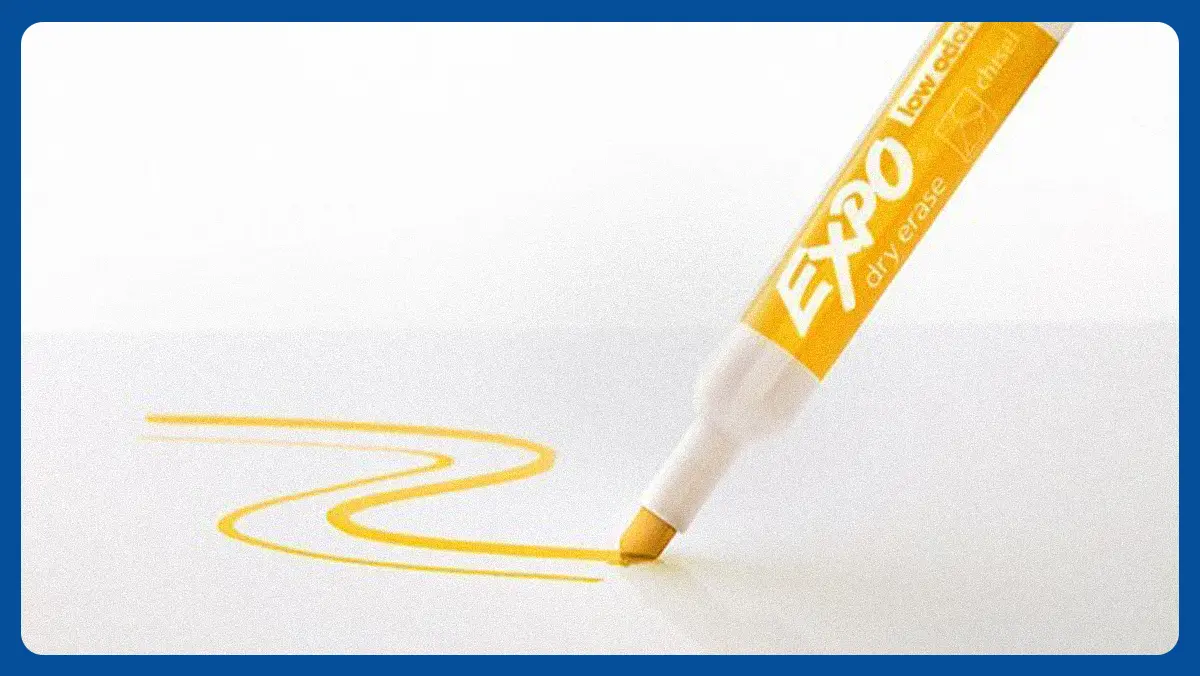
"It always starts with the unarticulated unmet consumer needs. People cannot tell you what they are missing or how they want to evolve their experiences in the home or at work, but if you watch them, you see compensating behaviors," says Malkoski. That methodology recently produced one of the more instructive product launches in the CPG space: the return of the EXPO yellow dry-erase marker, reissued in March 2026 after nearly two decades off shelves. The story behind the relaunch illustrates how a disciplined observation practice can surface demand signals from multiple directions simultaneously and connect them to real R&D investment, a model that brand leaders managing multi-product portfolios would do well to study.
Reading the room: The yellow marker's return didn't start with a market study. Workers on the floor of a Tennessee manufacturing plant approached leadership with a uniquely specific request: they wanted the company to bring back the classic yellow dry-erase marker so that their schoolteacher spouses could put a little sunshine back onto their whiteboards. That offline request mirrored a vocal community of educators on TikTok begging for brighter classroom tools. The convergence of factory-floor anecdotes and social platform sentiment gave the team a demand signal that neither source alone could have provided. But Malkoski's team didn't simply reissue the old product. The previous version was too sheer for modern whiteboards and slick surfaces, so the company had pulled it from shelves years earlier. Bringing it back required four years of stubborn ink reformulation. "It took a lot of chemistry and work," Malkoski says. "It sounds like it should be simple, but it really was not to maintain the erasability and have double the boldness of color."
Following surfaces, not segments: What makes Malkoski's approach distinctive is that it doesn't organize innovation around traditional consumer segments. It organizes around physical surfaces, a methodology that produces differentiated products in a market where most brands default to sameness. Once the team nailed the vibrant ink for classrooms, they noticed dry-erase markers appearing in kitchens and living rooms. People were hacking permanent or acrylic markers to label plastic food canisters, often ruining the containers in the process. That compensating behavior led directly to a new product: Wet Erase. "The Wet Erase can outline your monthly calendar," Malkoski says. "Say soccer practice gets moved from Monday to Thursday. You can erase soccer practice in your Monday square without the rest of it erasing and write it into your Thursday square. That is what I mean by permanent until you do not want it to be." The insight is that consumers weren't switching between product categories—they were moving across surfaces, and the brand needed to follow them there.
Glass walls as a signal: The same behavioral logic extended into the corporate world. Malkoski noticed her own colleagues writing directly on glass walls and doors to capture quick, collaborative discussions. That observation inspired R&D investment in making EXPO's inks visible on translucent surfaces—a move that, like Sprite's recent shift toward a unified global platform, shows how a single behavioral insight can unlock an entirely new surface for brand expression. "Today people want to draw on almost anything," she says. "The chief commercial officer who sits near me likes to write every day on the glass window on his office door. People are gravitating toward multi-surface discussion, organization, and iteration in real time, regardless of what surface they have in their space."
Malkoski compares this observational strategy to the early days of mobile technology, where the physical friction of carrying multiple devices sparked an entirely new product category. "Think about phones," she says. "People were juggling a camera and different things, trying to hold them all, and that was the compensating behavior people noticed when they thought about how to evolve the phone."
Once the functional chemistry is locked in, Malkoski's team layers the emotional dimension of the brand on top. For the yellow relaunch, that meant targeting teachers and what the team calls "analogers", people who still enjoy the tactile satisfaction of writing things down by hand. Drawing on color psychology that links yellow to optimism, the EXPO "Analogers" campaign takes inspiration from highly engaged, joyful entertainment brands like the Savannah Bananas.
Emotional architecture on a functional foundation: "Yellow is a warming, delighting color," she says. "Over the years, yellow in culture has stood for Tweety Bird or Winnie the Pooh or SpongeBob SquarePants. It is one of those things that just warms you up on the inside, and that is how we are trying to launch the campaign—around that emotional joy and warmth that comes from the color yellow." To land the message, the brand plastered teachers' actual social media comments inside the launch boxes, alongside branded hats and name badges, a tactic that positions the product relaunch as a community event rather than a transactional SKU addition.
For brand leaders managing complex portfolios, the EXPO playbook offers a useful corrective to the standard innovation process. Most CPG companies start with a market opportunity analysis and work backward toward a product. Malkoski's approach starts with the physical environment where consumers already live and works forward toward the friction they didn't know they were tolerating. In a landscape where authentic connection to real consumer behavior is becoming the baseline for brand credibility, that kind of observational discipline is what determines whether the remaining brands earn their place in the portfolio—or simply survive the cut.