B2B Marketers Want Proof for Every Dollar. The Best Campaigns Only Pay Off Later.
Everstage's growth chief funds slow-burn brand work, and scores every program by what a competitor would pay to copy it.
Make brandbeat one of your go-to sources on Google

In my mind, brand is a pipeline driver, but just on a longer time horizon than other marketing disciplines.

Abhishek GP
Most of the people who will buy from you next year aren't thinking about it yet. Reaching them is the job of brand marketing, the work of staying known and trusted before anyone is ready to buy. It's hard to measure, and the last decade taught B2B teams to tie every dollar to revenue, which made that kind of spending harder to justify. The teams pulling ahead now are funding brand again, even when the payoff takes time.
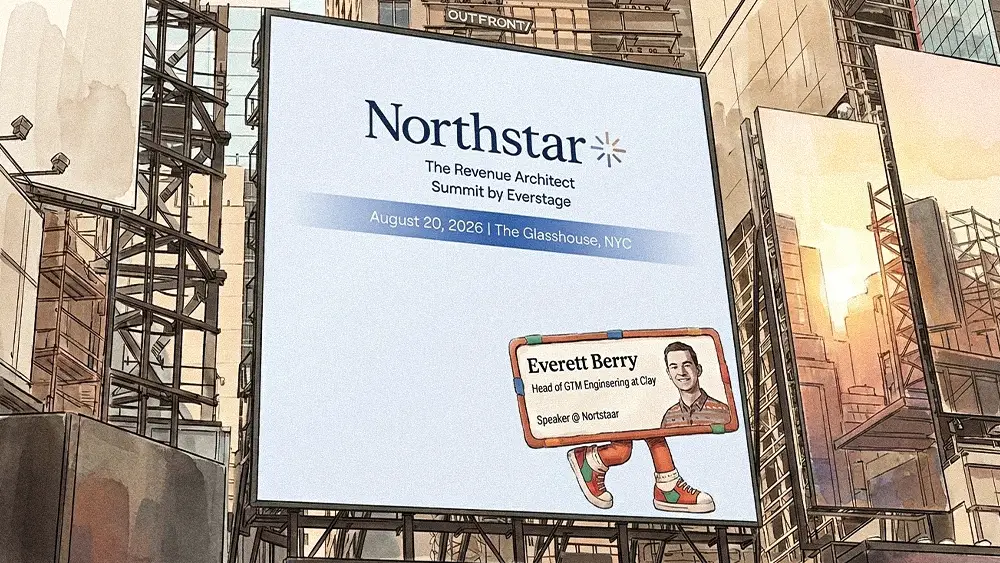
Everstage, which sells sales compensation and CPQ software, made that kind of bet on a Times Square billboard. It started with a comment on LinkedIn. The company had posted about Everett Berry, Head of GTM Engineering at Clay and a speaker at its Northstar Summit, and Clay replied that Berry was "a walkin billboard." Three days later, Everstage had rented a screen in Times Square and put Berry on it, making the joke literal. Most of the Broadway crowd would not be its buyers, so the billboard was built to travel online. Everstage filmed it, then ran the footage as a paid ad aimed at the revenue and sales leaders it wanted to reach.
Abhishek GP, Everstage's SVP of growth and brand, owns demand generation and pipeline on one side and the company's reputation on the other. He came up in consumer marketing at American Express and Philips, then spent years running growth at B2B software companies including Freshworks and Atlan. He treats the two as one job. "In my mind, brand is a pipeline driver, but just on a longer time horizon than other marketing disciplines," he said.
Expensive on purpose
The billboard worked because everyone who saw it knew what a Times Square screen costs. Spending in the open like that reads as commitment, because a company goes that far only when it means it. GP compares the effect to luxury, where being seen with a costly object passes some of its status to whoever holds it. "Doing a billboard campaign in real time in an expensive location in a catchment area where 90% of audience is not your buyers is a luxury. It's again a commitment and status signal," he said.
Everstage places the same bet in other formats. It makes merch people actually wear, and it mails a print magazine called The Compensator to the people who run sales comp. Each one shows buyers the company spent real money to reach them.
GP funds these by asking one question: what would it cost a competitor to run the same play? He scores every brand program twice, once for what it costs Everstage and once for what a rival would pay to match it. The gap between those two numbers is where he thinks the advantage sits. Northstar, the summit Everstage hosts for the people who run revenue teams, was built to sit in that gap. Everstage hired an outside host and gave her more stage time than its own CEO. It refused to pitch its product at the event, and graded the day on the energy in the room, a half joke metric GP named the Attendee Vibe Quotient.
More than a laugh
In a crowded category, being good is not enough to get noticed. A brand also has to be fun to be around. "The only way to stand out today, especially on social, is by listening and just being there, making sure you are a fun brand to hang out with," GP said. That takes real knowledge of the buyer's world, how they talk and what a stressful week looks like for them.
Being fun is not the goal by itself, though. GP's rule is that every stunt has to have a purpose before he runs it, some result he expects it to drive. He gives it a few months, then checks whether it actually moved anything. If it didn't, it was just for show.
AI makes this matter more. As more teams lean on the same models to fill their channels with content that's competent and forgettable, a company that does something a model can't copy gets easier to spot. The more everything sounds alike, the more real judgment stands out.
Where the payoff shows up
Brand spending is hard to pin down. It still leaves a trail. GP watches a set of numbers that tend to rise in order once a campaign catches on. Engagement on social moves first, since that's the quickest thing to react. Next, more people search for the company by name, because the work put it in their heads. Then direct visits to the website go up, people arriving by typing the name into a browser. A growing share of those now come from buyers who first heard about Everstage through an AI assistant, then went looking for it.
Everstage plans for this. GP said the team sets aside about 7% to 8% of its projects for experiments, campaigns built to work over six to nine months, and counts them worth it even when all they do is make more people remember the company. Once the visits start coming, the focus shifts to the website, and to what turns a curious visitor into a booked demo.
The billboard will never show up in a last-click report, and GP is fine with that. The B2B companies gaining ground are the ones still willing to spend on work that takes months to show up in pipeline, trusting that being seen and talked about turns into sales. GP has watched it happen on a delay. "If you give it enough time, you will start seeing results," he said.