DOOH Expands Across Participation, Creative, and Interactive Layers
New developments across participation, creative, and interactive formats are expanding how DOOH fits into modern campaigns.
Make brandbeat one of your go-to sources on Google

As programmatic expands into more environments, it gives advertisers access to moments that were previously harder to plan for. That opens up new ways to connect messaging with real-world actions.

Ben Milne
From creative built to capture the moment to shifts in operational workflows and more interactive formats, DOOH is expanding in multiple directions at once. What’s changing isn’t just the format, it’s how the channel fits into the broader campaign. DOOH is becoming more flexible, more operational, and more connected to how media is planned and executed. Here are three developments shaping how advertisers should be thinking about it right now:
Bottling the moment
Ocean Spray’s latest out-of-home activation in Melbourne shows how DOOH is starting to blend physical experiences with content generation.
The campaign reframes "happy hour" as a 6am wellness ritual, targeting early-morning runners, surfers, and fitness communities. A large-format billboard installation in St. Kilda offered free gear and drinks, inviting passersby to take part and shape the experience in real time. That participation became the foundation for the campaign itself. Moments from the activation were captured and turned into a stream of user-generated creative, which was then tested, refined, and amplified across additional out-of-home placements.
Instead of starting with a fixed set of assets, the campaign built creative from real-world interaction. The result is a model where DOOH acts as both a media channel and a content engine, generating material that can be optimized and scaled over time. Participation is reshaping how creative gets built, with campaigns evolving in real time based on what resonates.
"This kind of approach shifts how campaigns are built," says Ben Milne, APAC CEO for billups. "When you create opportunities for people to participate, you’re also creating a pipeline of content that can be used and refined across the campaign."
Creative in motion
Canva’s $30 million acquisition of Doohly highlights a shift happening behind the scenes in how DOOH operates.
Doohly’s platform handles the operational layer behind screen networks, including scheduling, content management, and reporting across retail and venue environments. At scale, this involves coordinating large volumes of creative and ensuring content is delivered accurately across locations.
Bringing this capability into Canva’s ecosystem brings creative production closer to execution. The gap between designing content and deploying it to live screens is narrowing, turning DOOH into something that looks more like a continuous content workflow.
As creative volume increases, especially with AI-assisted production, the focus is moving toward how that content is managed and deployed across environments. Managing creative at scale, across multiple locations and formats, becomes a central part of campaign execution.
"This is another step toward DOOH functioning as an always-on channel," says Milne. "When creative and execution are more closely connected, it changes how campaigns are built and maintained."
Playable by design
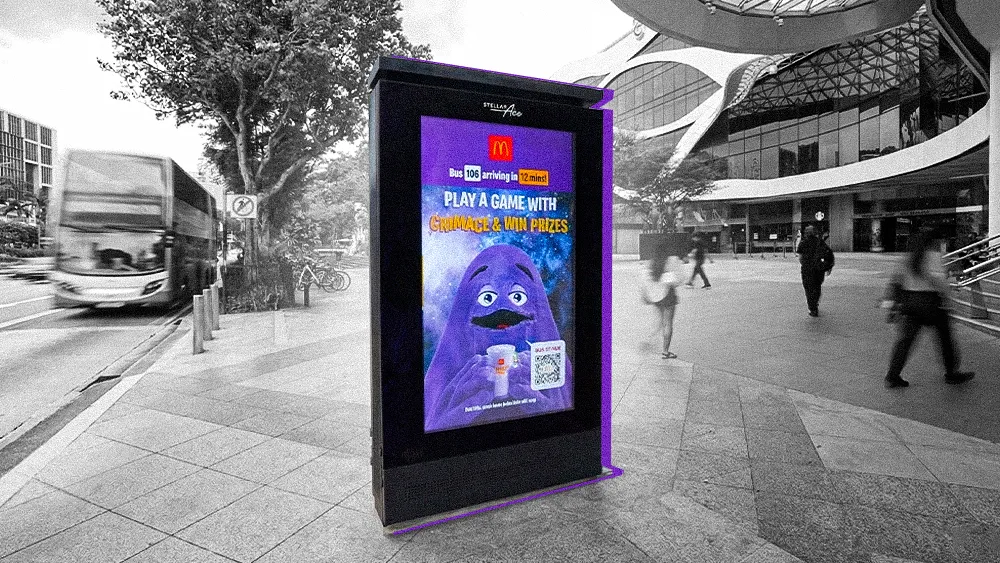
McDonald's Singapore’s latest Grimace campaign shows how DOOH is evolving into a more interactive format. The campaign uses digital screens in high-traffic locations to combine real-time transit data with branded content, prompting commuters to scan a QR code and enter an augmented reality game.
From there, the experience continues. Users who complete the game receive a reward through the McDonald’s app, connecting the initial screen interaction to mobile engagement and in-app activity.
The campaign also incorporates contextual triggers, adjusting content based on factors like bus schedules and weather. Additional formats, including 3D bus toppers, MRT train placements, and a physical pop-up, extend the campaign across multiple touchpoints.
DOOH is becoming more participatory, with campaigns designed to invite interaction rather than simply deliver a message. By combining interactivity, mobile integration, and contextual data, these activations create new ways to connect physical presence with measurable engagement.
"What’s changing is how people engage with the screen," says Milne. "When you introduce interaction and mobile integration, it creates a more active experience that extends beyond the moment of exposure."