ALDI Marketing Director Says Brands Win Trust By Showing The Proof Behind The Price
Katherine Sodeika, Marketing Director at ALDI USA, explains how the grocer's latest campaign earns shopper trust by making the reasoning behind its low prices part of the pitch.
Make brandbeat one of your go-to sources on Google

A lot of marketers still treat value as the lowest prices, but for shoppers, it's an equation.

Katherine Sodeika
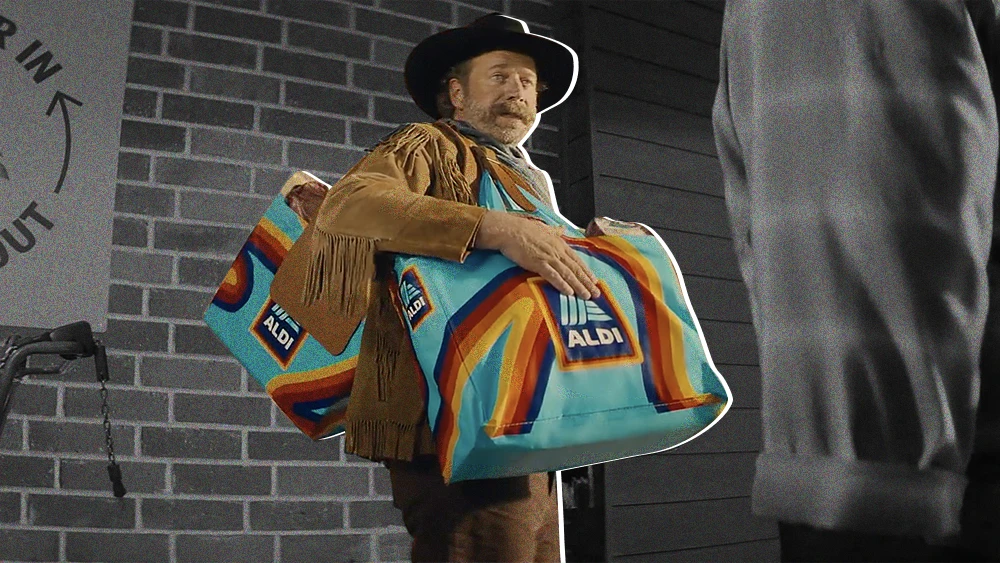
ALDI's newest campaign is built on a simple bet: shoppers trust a low price more when they understand why it's low. So the brand is showing them the operational quirks that make it possible, like the quarter that unlocks a cart and gets returned on the way out, or the aisles where ALDI's own labels fill most of the shelves. Explaining the mechanics of a business model is dry work, so ALDI gives the job to a guide who can make it land. A confident cowboy walks shoppers through each quirk with a straight face. The spots are the latest chapter of It's an ALDI Thing, the brand platform ALDI has run across its national advertising since 2022. The franchise turns on the small thrill of finding a good product at an unexpectedly low price.
Katherine Sodeika is Marketing Director at ALDI USA, where she shapes the brand's national marketing strategy. She spent most of her decade at the company on its operations and e-commerce side, helping pilot ALDI's first curbside pickup locations before the program reached hundreds of stores. That path gives her a close-up view of how ALDI's model works, the same model the campaign sets out to explain, and it informs how she reads value, a problem she thinks many marketers oversimplify.
"A lot of marketers still treat value as the lowest prices, but for shoppers, it's an equation," Sodeika says. Savings matter, but so does whether the product is good and whether the trip is easy. When the price is right, but the quality or the experience lags, the math stops working.
Two carts, one ad
ALDI's data flagged the store choices that give newcomers pause, and the campaign built the cowboy's spots around explaining them. From there, the same spots have to do two jobs, since the audience splits between people who have never shopped ALDI and people who shop it every week. For newcomers, the goal is to make the unfamiliar feel approachable and to show that ALDI's choices are deliberate. "They already know ALDI is different, so we need to show that those differences are intentional and actually work in their favor," Sodeika says.
For regular shoppers, the job moves from teaching toward discovery, nudging them off their usual route and steering them past their standby favorites. The cowboy and his dry delivery hold steady for both groups, which keeps the brand recognizable whether someone is meeting the quarter-cart logic for the first time or hearing it as an inside joke.
Sum of the parts
Value built from several pieces gives a brand a lot to convey, and cramming it all into one ad tends to muddy the message. ALDI's way around that is to let each quirk make one part of the case, the quarter cart standing in for how it trims labor, the private-label aisles for how it avoids national-brand markups. "ALDI things aren't just differences. They're proof points of our value," Sodeika says.
ALDI keeps to one proof point per spot, so the full story never competes with itself. "The more layered the value proposition, the easier it is to overcomplicate it," Sodeika says. For any brand whose appeal runs on more than price, that story still has to stay legible, or the pieces start to blur.
Channel surfing
A viewer meets this campaign in more than one place, and ALDI builds each version around how people watch on that surface, from a national television spot with room to set up the world to shorter online cuts that carry the cowboy's voice in a fraction of the time. On social, the loosest of the formats, the team starts from the trends its audience is already in and looks for the piece they'll want to share, the kind of reach that depends on someone choosing to pass it on.
Spread across that many surfaces, a campaign can splinter into a set of unrelated ads chasing the same viewer. "The goal isn't consistency through duplication. It's consistency through a shared idea," Sodeika says.
The long game
The campaign is judged on whether it moves perception. Awareness only sets the floor, so the team tracks something harder, whether newcomers walk away understanding why ALDI runs the way it does, and whether regulars grow more loyal. Those two shifts feed the underlying business targets, bringing in new shoppers and getting existing ones to visit more often and spend more when they do.
That approach, anchoring each spot in a reason, can outlast a single flight of ads. ALDI returns to the same idea each season and lets each channel carry it differently, so one season builds on the next. "Our task isn't just to show the value we provide. It's to clearly show how we deliver it time and again to our shoppers in ways that are distinct to us and exciting to be a part of," she concludes.