Gotham FC Anchors Its Queens Relocation On Contextual Out-of-Home Two Years Early
Laura Petro, Vice President of Brand and Fan Experience, and Roberto Max Salas, Co-Founder and President of Young Hero, lay out the placement and creative decisions behind a two-season street-level campaign.
Make brandbeat one of your go-to sources on Google

When they read about us in the New York Times, they can then see us on their street corner and be reminded that we're coming.

Laura Petro
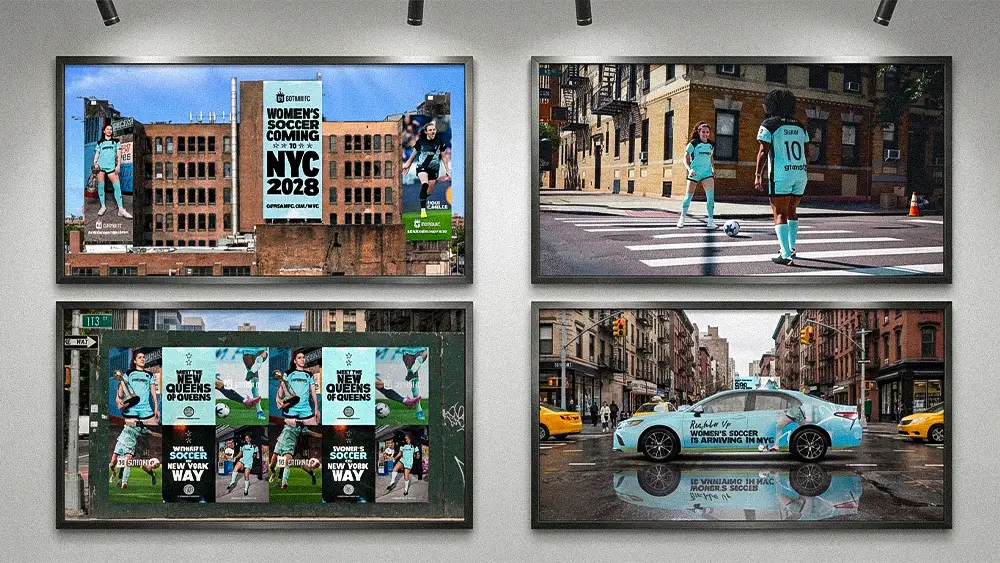
Gotham FC put paid out-of-home at the center of the campaign announcing its 2028 relocation to Etihad Park, buying bus shelters, transit boards, taxi wraps, and moving van takeovers across New York with a run extending into the fall. The club will not play a match in Queens for two more seasons, which removes the usual reason to buy street-level media and replaces it with a longer one. Gotham FC has played its home schedule in New Jersey since the club was founded, and until this July had never hosted a match inside New York City limits. The club is putting media into the New York market roughly two years ahead of the team, working to make a home address feel real before the building holding it exists.
Laura Petro, Vice President of Brand and Fan Experience at Gotham FC, made the call to run an above-the-line campaign at a scale the club had not attempted before, working with Roberto Max Salas, Co-Founder and President of Young Hero, on creative that had to function as a 60-second film and as a static image someone passes at seven miles an hour. Petro's team competes for attention against every professional franchise in the country's densest sports market. To reach that market, Gotham FC worked with media agency Gupta Media on the campaign's strategy. Salas built the creative around what a New Yorker recognizes on the street, casting a Queens bodega corner as the setting for the announcement film and pulling the visual system for the static placements from the same world.
"When they read about us in the New York Times, they can then see us on their street corner and be reminded that we're coming," says Petro. Her framing puts out-of-home in a specific relationship to earned coverage, giving the buy a job that press attention cannot do on its own. A bus shelter reaches the same person in the neighborhood where they live, on a schedule the club controls, for as long as the club keeps paying for it. Gotham FC drew a sellout to Citi Field in July that demonstrated appetite for the sport in New York, and the out-of-home buy is designed to hold that interest through two seasons in New Jersey.
Buying the commute
The most specific work in the buy sits inside the Long Island Rail Road, where boards run on the line that will carry supporters to Willets Point once the club moves. Transit was the fastest-growing out-of-home format in the first quarter of 2026, up 18% year over year, and the format solves a problem general awareness placement can't. Someone reading a rail board is already on the system that reaches the stadium, which turns a brand message into a piece of practical information about a trip they have not taken yet. "There are contextual out-of-home boards inside the Long Island Rail Road that start educating people on the fact that it will be one way to get there when 2028 arrives," Salas notes.
Salas points to the persistence of the buy as what's doing the work, ahead of any reach figure attached to it. A relocation is abstract until someone encounters evidence of it in the course of an ordinary day, several times, in places they were going anyway. The campaign runs through the fall across formats a New Yorker cannot avoid on a normal commute, which produces repetition without requiring anyone to seek the club out. "It's already cemented when New Yorkers are out," says Salas. "They see it, and it's here."
Boxes in the back
The static creative had to communicate a relocation that has not happened yet, and the team solved it with a literal image. Campaign photography shows Gotham FC teammates Rose Lavelle and Jaedyn Shaw, seated in the back of a moving truck. A viewer can process the meaning in under a second without reading a word of copy, which is the requirement for any placement a person passes at speed. "Some of the photography shows Rose and Jaedyn sitting in the back of a New York moving truck with Gotham boxes and logos," Salas explains. "Strategically that lets people know the team has moved."
The visual system pulls from two separate sources. Alongside the campaign photography, the team layered in match images from the club's in-house content team photography, which keeps Lavelle and Shaw recognizable as athletes in placements where they could otherwise read as models in kit. The design system behind the static work takes its colors from whichever kit the players are wearing, and every layout is built around a moment of in-play action. "Gotham actually has a very unique brand of playing style, and ultimately soccer is really what is at the core of this campaign," Salas notes.
Measurement, honestly
Petro is candid about the limits of what the buy can prove, which puts her in the same position as most marketers running large-format placement against a long horizon. The team applied rigor where rigor was available, selecting locations against expected foot traffic and modeling exposure in advance, while accepting that the channel resists the attribution standards applied to paid social. Measurement in out-of-home has advanced through mobile location data and brand lift studies without reaching the resolution of a click. "Any marketer will be honest enough to say out of home is not something you can really scientifically measure," says Petro. "We were very scientific in terms of location choice and expected footfall and tried to be as precise as possible."
The answer to the attribution problem is structural. Gotham FC bought out-of-home alongside connected TV, paid social, immersive display, and a one-day New York Times takeover, and Petro evaluates the combination on what it produces together. Other brands have found that a large out-of-home buy lifts the channels around it, working as a foundation that paid and CTV perform against. The outcome Petro is buying toward won't appear in a campaign report, since recognition in Queens and Jersey City accumulates across two seasons and outlasts the relocation that paid for the media. Petro applies the same horizon to the club itself, where two league titles in three years have not produced a finished product. "Our mantra is always building, never finished," she concludes. "For a team that's won two championships in three years, that's a pretty humble and hustle mindset to have."