Habit Burger & Grill Launches Its Chef Residency On A Single Out-of-Home Placement
Georgia Schreiner, Media Director at Exverus Media, and Todd Eisner, Partner and Executive Creative Director at Optimism BH, share why one digital screen anchored the Habit & Co. launch and how it was measured.
Make brandbeat one of your go-to sources on Google

There's just a tangibility to out-of-home that can be really impactful when it's a brand saying, 'Yes, we are going to quite literally plant our flag in the ground and say, this is what we want to say and this is what we stand for.'

Todd Eisner
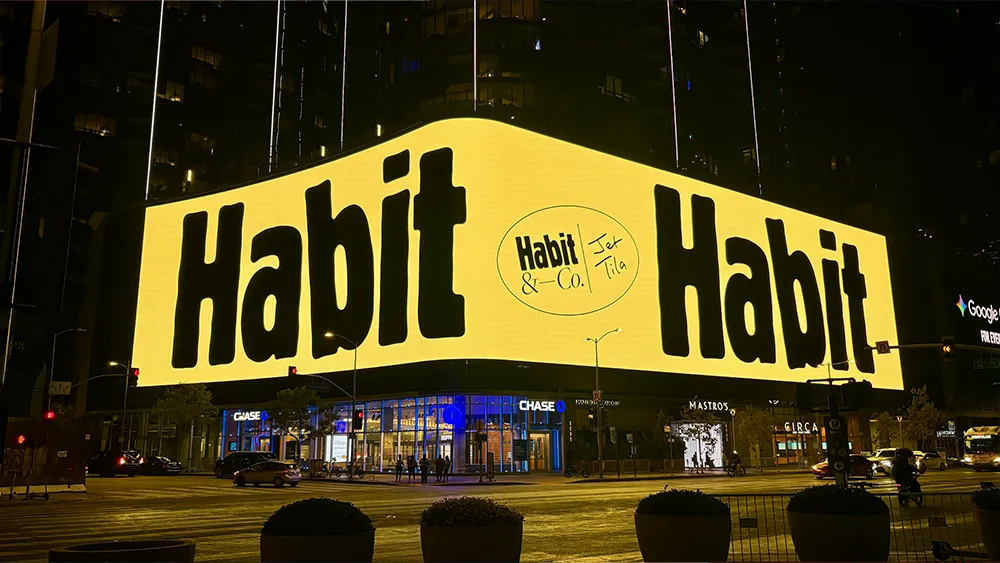
In late July, Habit Burger & Grill launched Habit & Co., a chef in residency platform that hands the menu over to three collaborators for eight weeks each through January 2027. Jet Tila took the first residency with a Korean Street Menu, now available at restaurants nationwide. The campaign's entire paid out-of-home presence came down to one digital unit in downtown Los Angeles. Exverus by Brainlabs and Optimism BH built the plan around that single placement, carrying the announcement for the whole platform.
Georgia Schreiner is Media Director at Exverus by Brainlabs, the Los Angeles agency that plans and buys media for Habit. Schreiner was named Ad Age Media Planner of the Year in 2023 after more than a decade in planning and buying roles. Todd Eisner is Partner and Executive Creative Director at Optimism BH, the independent San Francisco agency behind the Habit & Co. creative, where he has led creative work since 2016 following roles at Argonaut and Goodby Silverstein & Partners. Schreiner planned and bought the placement against Habit's business goals, and Eisner built the fifteen seconds of video the screen carried at launch.
"There's just a tangibility to out-of-home that can be really impactful when it's a brand saying, 'Yes, we are going to quite literally plant our flag in the ground and say, this is what we want to say and this is what we stand for.' When done right, that generates its own kind of buzz," says Eisner. Habit was new to the chef residency concept. The structure asked the launch to announce a format that would turn over three times across six months, and the media plan answered with physical presence in Los Angeles.
Anchoring the launch
Exverus by Brainlabs started the plan from a question about attention. Schreiner and her team spent the early sessions working out what makes an audience treat a campaign as an event. The answer came down to a short list of requirements that shaped the buy. "We know that this was really an ambitious thing that they were doing for the first time, wanting to really elevate the whole collaboration into this true residency," Schreiner says. "Part of it was how do we make this feel more like a cultural moment, something very buzzworthy. Not just, oh, we're slapping a famous person's name on it. We came down to something that is iconic, something with credibility, and then a whole ecosystem around it that makes it really unavoidable."
The team weighed spectaculars, wall murals, and other tactile formats before choosing a digital screen in downtown Los Angeles. Schreiner ruled out those formats because she wanted the creative team to have as much flexibility as possible. An editorial partnership supplied the credibility requirement, and a robust paid campaign covered the surrounding ecosystem. Schreiner points to what a screen at that scale does in the moment a campaign goes live. "Something iconic, that's what came to life with the big out-of-home moment," Schreiner notes. "You can't miss it. It signals that this is a really cool thing you need to pay attention to."
Diving into dynamic design
Settling the format left the harder question of what would appear on the screen. Each resident chef brings a distinct aesthetic to Habit & Co. Eisner's team built separate colorways for all three, giving every arrival its own look while holding a through line that keeps the campaign recognizable across the year. Schreiner's team found a media reference point for the rotating format in a category well outside quick-service restaurants. "It's not unlike a Vegas residency, where you have the digital signage getting people excited and hyped," Schreiner explains. "That was the idea we borrowed to bring what we think of as a residency to life with a large out-of-home unit."
The placement wrapped a building and ran fifteen seconds of video in front of heavy foot and vehicle traffic. Eisner's team had to carry a story across a surface that bends and a runtime that allows a passing viewer one look. "It wraps around a building, so we're not just looking at kind of a flat space, we're looking at a curved space," Eisner says. "The amount of foot traffic and drive by traffic is really kind of amazing. It's so high-profile. Part of the consideration was how are we not just going to be there and be kind of loud, but how do we tell that story in 15 seconds in a way that's simple enough to digest but also gets people walking out of the arena or driving by to turn their head?"
The team tested the creative before it went live to confirm the message registered at speed. Early versions leaned into dynamic motion that looked strong in an edit bay and risked losing a driver moving past. Other options filled the runtime without earning the space. Eisner treats the format's limits as the useful part of the assignment. "The great thing about out-of-home is it kind of forces you to distill an idea down to the essentials, and be really crystal clear about hierarchy," Eisner adds. "The most important thing was for people to know it's from Habit. Then to let them know that Jet Tila is our first resident, and let them know he's making a Korean street food menu."
From screen to storefront
A placement of that scale draws scrutiny from the client side, and Exverus by Brainlabs tied a business outcome to the screen before it went live. Schreiner describes a foot traffic attribution model running against the unit, which tracks people who pass the screen and later visit one of the twenty nearest Habit locations. She puts the attribution work in the context of what the Habit account generally asks of media. "Everything we're trying to do for Habit is leveling up," Schreiner says. "Every piece of media that we run is tied to a business outcome. Proving that our media is moving the needle in the way that the Habit team needs it to move, out-of-home is no exception there."
Optimism BH worked under the same pressure from the creative side. A campaign running dozens of boards can reuse one layout everywhere and absorb the inefficiency across the buy, while they had one placement, one running time, and one unusual shape. Eisner sees a screen of that weight asking for creative made to its measurements. "If we had 100 outdoor boards and we just applied that to this, it wouldn't be nearly as impactful," he concludes. "You can't just slap any layout on it. A unit with this kind of investment requires a very bespoke approach, and it's also the right thing to do, because it really maximizes the effort."