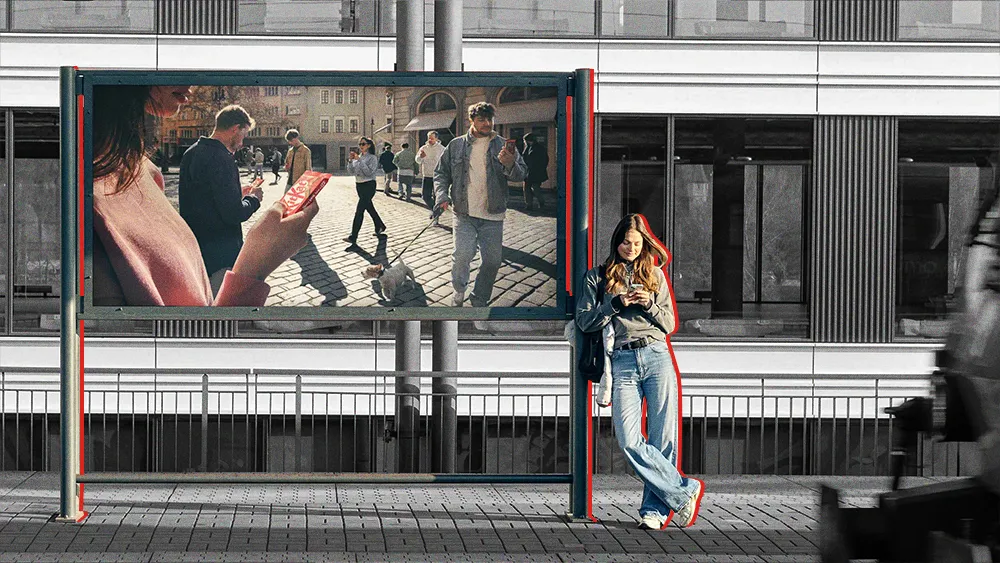
If it works on out-of-home, you know it's a strong idea because it's so simple. That, for me, is always the litmus test of a great idea.
 Wael JabiGlobal Head of Marketing and Communications, KitKat @ Nestlé
KitKat has won a Cannes Lions Grand Prix in each of the last two years, one for a campaign the brand planned and one for a response it improvised. Phone Break, the brand's Czech out-of-home campaign from VML Prague, took the Outdoor Grand Prix in 2025. A year later, The KitKat Heist took the PR Grand Prix for Nestlé's answer to a genuine robbery where thieves stole 413,793 bars in transit from a factory in central Italy to Poland. Both awards rest on the same line KitKat has carried for decades, and on an out-of-home discipline that reduces every idea to its simplest form.
Wael Jabi is Global Head of Marketing and Communications for KitKat at Nestlé, a role he has held since 2021. Jabi joined Nestlé in 2018 as Global Strategic Digital Partnerships Lead, arriving after more than a decade at Procter & Gamble. He was Global Brand Director for Braun there and held brand roles on Pampers and Gillette across the Gulf region and Sub-Saharan Africa. His work covers a brand Nestlé sells worldwide on a single positioning it has held through every change of ownership, agency and generation.
"If it works on out-of-home, you know it's a strong idea because it's so simple. That, for me, is always the litmus test of a great idea," says Jabi. Every creative agency presentation he sits through arrives with an out-of-home execution in the deck. The same test carries over to print, where a static visual has to explain the idea on its own. Jabi traces KitKat's recent run to a target Nestlé's management set a few years ago, telling teams across the company to become the best marketers in the industry.
Reaching the infrequent buyer
KitKat competes in a category where shoppers decide in the aisle, in seconds, on impulse. Nestlé's sales teams cover what Jabi calls "physical availability", the work of getting the bar onto the shelf where that decision happens. Out-of-home handles the half that runs before the shopper arrives. "One of the things that we want to drive is mental availability, because that is one of the drivers of brand penetration," Jabi says. "The majority of our sales is driven by people who buy the product so infrequently, so you need to drive that extra new user. Out-of-home helps me do that because it's able to get into people's minds and maybe trigger that thought process as they're in the store buying something else."
KitKat has run the same positioning since a J. Walter Thompson copywriter named Donald Gilles wrote "Have a break, have a KitKat" for the brand. The line survived the sale of Rowntree's to Nestlé in 1988, and every campaign since has been built on top of those six words. Brand managers arrive on the account wanting to leave their own mark on the line, and Jabi treats holding it steady as one of the basic laws of marketing. "Something so straight and boring about one simple positioning, a lot of people look at it and they feel like it's restricting them," Jabi explains. "But because we've put all the creatives in a really tight box, they're able to break free through that and find ideas that are really, really strong."
Same line, new tension
Little Breaks, KitKat's UK out-of-home campaign this year, drops the tagline and asks the logo alone to carry the message. VML UK ran it across London Bridge, King's Cross St Pancras and other busy transit hubs. Each poster shows a cropped KitKat logo with a hand-drawn figure hidden in its curves, reading, playing guitar or daydreaming. An earlier digital poster at London's O2 Arena had shown the words "Have a" and a blinking cursor in place of the rest of the line. "Little Breaks was positioned in the UK, where the brand was born," says Jabi. "It is my oldest market. It is the most mature KitKat market in the world. And so we believed we had a right to play with our distinctive brand assets."
Little Breaks and Phone Break both started from research into how people rest. Jabi's team found that audiences already understand the value of a break and say they take plenty. The Czech campaign swapped smartphones for KitKats in ordinary street scenes and left viewers to supply the line. "What we're seeing is that the quality of those breaks are not strong enough," Jabi notes. "People aren't feeling fulfilled after having their breaks. Maybe it's because of the mindless scrolling, maybe it's their worries. Whatever it is, they're not having proper breaks."
Jabi briefs each campaign against a different pressure on the same idea. Scroll fatigue supplied the subject for the Czech team. VML UK worked from advertising fatigue, describing Little Breaks as an antidote and building posters that reward a second look. "Our positioning is static, but how people perceive that positioning is evolving generation after generation," Jabi explains. "What a break meant to my father and his father is very different from what a break means to me."
Fixed points and flex
The KitKat Heist started from a shipment of the brand's Formula 1 bars and news of the loss reached audiences far beyond KitKat's paid media. Nestlé published a KitKat Tracker that let shoppers enter the batch code on any bar and check it against the missing consignment. The response drew a 31% share of voice across 93 markets and $224 million in earned media inside ten days, and the jokes that followed came from consumers. "You know your brand is working really well when people talk behind your back and are able to exactly represent your brand fundamentals," Jabi adds. "All of our distinctive brand assets that we've worked so hard to bring into people's minds over decades are showing up in memes, on Instagram, on TikTok."
KitKat sells into markets that run their own local sponsorships, and a global partnership has to work alongside those deals. Nestlé named KitKat the official chocolate bar of Formula 1 in a multi-year deal, its largest global brand partnership, running across twelve races this season. Formula 1's growth among younger and female audiences drew Jabi to the sport, along with the way Netflix's Drive to Survive built the drivers into characters. "We have our non-negotiables, and then we have areas where we flex," he notes. "Canada can't do Formula One by itself. We need Canada, we need Brazil, we need the UK. We need all these big markets to come together so that we can get into these big partnerships."
The work Jabi names as his own favorite predates his time on the brand. KitKat Philippines put Breaker Benches across the country's busiest business districts, choosing the areas where office workers were most likely to want a pause. The team varied them so a passer-by could pick the kind of rest they wanted, setting musical benches alongside a soccer bench and a seesaw. "The team at the time did a wonderful activation with park benches," Jabi concludes. "They used a very obvious KitKat asset, turned it into KitKat bars, and invited people to have a break. It's a beautiful mental shortcut of our positioning."