How Café Bustelo Carries Its Can Artwork From Shelf To City Wall
Josh Williams, Director of Brand Experience, Coffee at The J.M. Smucker Company, and Yohan Daver, Executive Creative Director at BBH USA, explain how the murals carried artwork drawn for a coffee lid.
Make brandbeat one of your go-to sources on Google

We put a lot of muscle behind out-of-home because it can be a true differentiator. Bringing murals was such a cool way to really show the artistry of this campaign.
Josh Williams
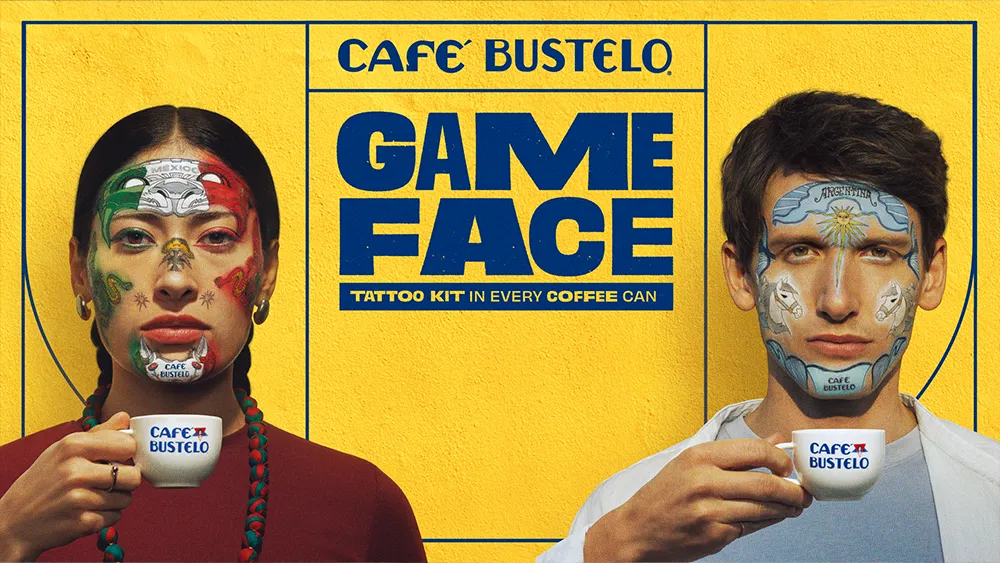
Café Bustelo is an espresso-style coffee brand with Latin American roots, and for the 2026 World Cup it ran a campaign called Game Face built on its packaging. Argentina, Brazil, Colombia, and Mexico each got a limited-run can design drawn by an artist from that country. Every can held a sheet of temporary tattoos beneath the lid, so fans could wear their country on their face at a match. The same four illustrations were later painted by hand onto the sides of buildings in American cities, where they ran alongside billboards, films, and social work built from the same designs. Those walls went up weeks after the cans reached shelves, carrying artwork that had been drawn for a coffee lid.
Josh Williams, Director of Brand Experience, Coffee at The J.M. Smucker Company, set the brief for the campaign. Yohan Daver, Executive Creative Director at BBH USA, led the creative work, which ran through PSOne, the collective of Publicis Groupe agencies that handles Smucker's business. They started roughly a year before the tournament opened, which is a long runway for an event the brand had no rights to. Café Bustelo already backs Inter Miami and the Chicago Fire, and Game Face was the attempt to reach past the audiences those deals cover.
"We put a lot of muscle behind out-of-home because it can be a true differentiator. Bringing murals was such a cool way to really show the artistry of this campaign," says Williams. Out-of-home has been drawing larger budgets across the industry as brands look for placements that reach people away from screens. A mural is among the slowest of those placements to produce. An artist has to be on site, the result cannot be reprinted, and nothing about it can be moved once the paint dries. Committing to walls that early meant knowing what the artwork was months in advance.
The can behind the wall
All four cans reached retailers nationwide in the first days of June. The illustrations had been approved long before any media was booked, so the walls, the films, and the social posts all used work that had been drawn for a coffee can. Williams asked for the campaign to be built in that sequence, with the can finished first. "The Café Bustelo can is so recognizable, so iconic," he says. "We wanted to transform that brand asset into the centerpiece of this campaign. Once we figured out how to get those tattoos on the can and dress it up with that beautiful artwork, it made those limited edition designs so collectible and shareable and culturally meaningful."
Smucker prints and ships cans regardless of what the marketing plan says, so putting the campaign on the packaging added no media cost. Every other placement, from the murals to the television spots, had to be paid for. The campaign was later named one of the tournament's standout marketing efforts. "Packaging is a comms channel," says Daver. "It's the one thing the consumer actually touches, feels, and holds. They can pick it up and put it down and think it's not for them, or pick it up and think that's really cool."
Packaging at this scale is a meaningful investment, and a limited run has to earn its place in the plan quickly. Game Face had June and July, and the cans came off shelf when the tournament ended. "Your packaging should be part of your innovation pathway," Williams notes. "You can go try to hit that home run with a new product formulation or a new flavor or format. You can also hit those singles and doubles that help build your sales pipeline by focusing in on your packaging."
Handing over the canvas
The illustrations came from four artists working under the design studio Brand New School. Raul Urias, Mel Cerri, Josefina Schargorodsky, and Tami Hadid each drew for the country they live in, pulling from local flora and fauna, national iconography, and culturally significant patterns, symbols, and colors. The brief they were given was unusually short. "Each of the designs has its own unique style, because we didn't give too much of a guardrail," Daver explains. "Our idea was to give them a canvas. How would you want to represent your culture, your country, Latin spirit, or this global stage world event?"
Café Bustelo hired the rest of the production the same way. The campaign film was shot in Mexico City by a Mexican director, cut by an Argentinian editor, and scored by a music house based in Argentina. BBH saw some of that work only after it was done. "The partners you pick are going to make such a difference, and you give them an actual place at the table so you're not dictating what they do," Daver adds. "They got actual football fans into a studio to sit and chant. They would send us clips of the recording session, and we weren't even part of it."
Hiring locally gave the campaign credibility, though it gave the brand no standing at the tournament itself. Café Bustelo held no rights, which meant it couldn't use the event's name or marks anywhere in the campaign. Brands in that position have to build from what they already own. Café Bustelo has been selling coffee since 1928 and advertising in both Spanish and English for years. "We might not be the official sponsor, but we have a right to celebrate Latin spirit," Daver points out. "This is a brand built by immigrants. It has Latin heritage as part of its DNA, and artistry has always been a part of this brand."
Staying in the neighborhood
The four country illustrations went up on building walls in neighborhoods where Café Bustelo already sells, running alongside standard billboard placements. Each mural was done by hand, which put artists on scaffolding for days at a time, in public, in front of the residents the work was made for. A printed poster, by comparison, goes up overnight and comes down on schedule. "Those are spaces where it's a media buy, so technically speaking somebody can paint over them," Williams explains. "We wanted to create something that when those do get painted over, people are bummed out about it, that those were so beautiful they became part of the community."
Café Bustelo has now put money into out-of-home on two campaigns. Williams came out of the second one with a future-forward request. "These murals are a perfect representation of who we are as a brand," concludes Williams. "We should start building in murals as part of our overarching yearly strategy. It's a way for us to display our artwork."