Advil's Flywheel Pairs OOH With Athlete Storytelling And Live Activation
Natalie Halpern, Senior Director of Marketing for Advil at Haleon, shares how out-of-home turned an integrated soccer campaign into a public presence that carried past feeds and into New York streets.
Make brandbeat one of your go-to sources on Google

We had out-of-home, we had a ton of social content, and a lot of that was filmed and created at this event. It was this flywheel effect of everything working together.

Natalie Halpern
The brands stitching together campaigns that survive outside the scroll are building around a physical anchor. Advil's summer Rewriting Pain campaign is a working example: a New York City activation generated the content, out-of-home ads across the city gave the message a public presence, and the digital and social layer carried what the event produced into consumer feeds. The play sits inside a broader move toward experiential and in-person formats as consumers become harder to reach through screens alone.
As the Senior Director of Marketing for Advil at Haleon, Natalie Halpern runs an $800 million playbook with end-to-end P&L responsibility. Armed with two decades of CPG experience, Halpern previously earned Haleon's CMO Marketer of the Year award for delivering Centrum's first full year of market-share growth in over half a decade. Now, she's spearheading Advil's "Rewriting Pain" campaign, which builds on the brand's clinical credibility as an NSAID (its Dual Action formulation holds the American Dental Association Seal of Acceptance) to challenge the "no pain, no gain" mentality prevalent in sports culture.
"We had out-of-home, we had a ton of social content, and a lot of that was filmed and created at this event. It was this flywheel effect of everything working together," says Halpern. The campaign's counter-argument was grounded in Wakefield Research commissioned by Advil. Among everyday athletes surveyed, 88% have heard "no pain, no gain" from coaches or trainers, and 79% say phrases like "push through the pain" can encourage them to ignore body signals.
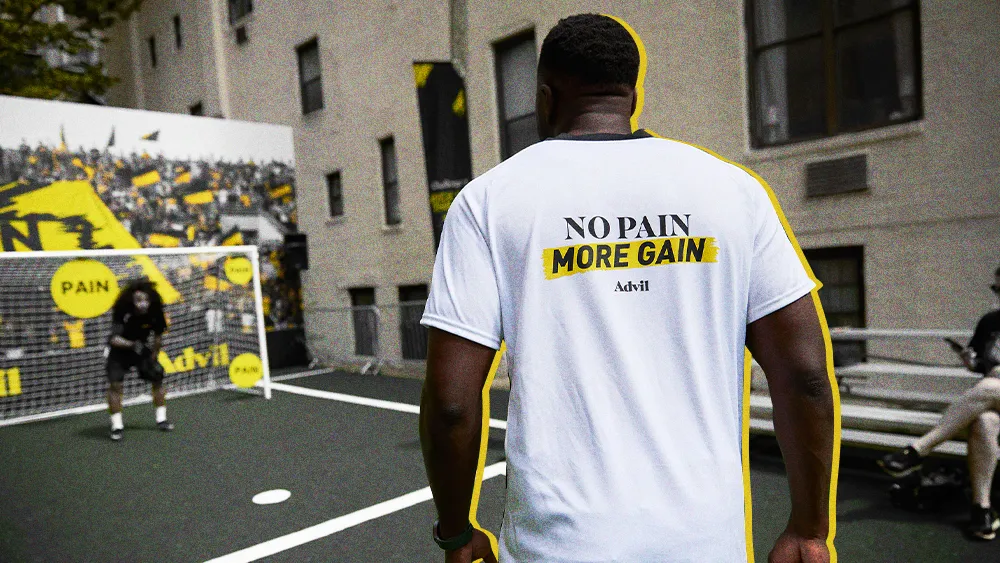
The brand's New York activation translated that argument into an experience where attendees kicked soccer balls at targets labeled "pain," giving Advil's inflammation-targeting product difference a physical form of expression. "The event that day in New York City was the anchor," Halpern notes. "I think that was the breeding ground for the content, and everything could kind of grow and explode from there."
OOH earns its comeback
Out-of-home was a major spoke in the flywheel, and it was the piece Halpern didn't see coming. She hadn't run an OOH campaign in years before this one, and the renewed thinking about physical media as a social trigger landed for her personally when friends started sending her photos of Advil's placements around New York City. "I had friends who walked by different vehicles in New York City where they saw an Advil out of home ad and sent me a picture, and they were noticing," Halpern recalls.
Halpern's framing of the moment is that consumers are looking for reasons to be present in the world around them. A well-placed physical ad now competes for attention against the phones people are trying to put down. The Advil OOH run gave the New York event a public presence it wouldn't have had on a social feed alone.
Jozy Altidore's role in the integrated campaign is where athlete storytelling connected everything together. His firsthand experience of playing through pain gave the message the credibility a scripted celebrity endorsement wouldn't have supplied. "I think it's really easy when you're sitting on the brand side to get some recommendations from an agency around who to partner with and go straight to how many people are following them and how many impressions they are generating," Halpern notes. "We went a little bit deeper to understand Jozy's story and what he is like to partner with. Does he like Advil? Is he excited about the idea? Does he agree with us that you don't have to push through pain?"
Beyond the World Cup buzz
Advil's Rewriting Pain campaign points at a transferable model for brands trying to survive in a media landscape where the feed alone doesn't carry a message far enough. The build order is a physical experience that generates the content, out-of-home ads that push the campaign into public space, and a digital and social layer that carries what the event produced. Halpern's takeaway is that the model works when the cultural moment and the brand belong to each other in the first place. "The campaign showed us the importance of showing up in culture in ways that are natural and relevant to the brand," she explains.
Advil is still watching how OOH performs as a channel for the brand going forward, and Halpern is treating the Rewriting Pain campaign as an early test of the model. The question she holds open is whether the physical media renaissance endures when the cultural tailwinds of a global tournament aren't behind the placement. "We've got to learn and see how the campaign actually performed and how we're feeling about that," Halpern concludes. "I'm excited to see a little bit of that renaissance and find other ways to show up again for consumers and culture beyond the screen."
Advil and Wakefield Research surveyed 1,000 U.S. adults (18+) who are current and former athletes in May 2026 with a web-based questionnaire. “Athletes” were defined as those who currently compete or have competed in a sport previously (e.g. collegiate, club, recreational, etc.). The respondent pool does not include professional athletes.