Out-of-home is really one of the most democratic ways of being able to get your message out to people. They don’t have to go to a specific website, look up a search, or just happen to see our ads show up on Google.
 Jason FarmerVice President of Marketing and Creative @ AIDS Healthcare Foundation (AHF)
Digital marketing in 2026 is obsessed with precision, with hyper-targeted algorithms doing the heavy lifting on most campaign budgets. The dynamic creates a real reach problem for organizations trying to connect with vulnerable communities, where the people who most need to receive a message are often the ones least likely to surface in a digital audience segment. Part of what's driving the current resurgence in out-of-home advertising is exactly this gap, with billboards offering an unfiltered way to reach populations who fall outside conventional ad buys. The medium exists in the physical world and meets people where they already are, no search history or opt-in required.
Jason Farmer, Vice President of Marketing and Creative at AIDS Healthcare Foundation (AHF), treats physical media as a core care-access strategy. Over his 21-year tenure, Farmer has built the visual language and out-of-home advertising that supports AHF's footprint of over three million patients worldwide. His view is that outdoor media serves as an inclusive channel, giving people the discretion to take in care information privately and without commitment. Executing that strategy comes with its own set of challenges, including navigating creative pushback from outdoor vendors on messaging that addresses sensitive subject matter directly.
"Out-of-home is really one of the most democratic ways to get your message out because people don't have to go to a specific website, perform a search, or happen to see our ads show up on Google. Anyone out there will see the graphics on our billboards, and that's our first pathway to get them tested or into care," says Farmer. For organizations operating in sensitive categories, that democratic reach often runs into real-world friction. Outdoor vendors regularly push back on direct messaging tied to sexual health, leaving creative teams to find another path to the same audience without diluting the message in the process. "We have to figure out a way around that to still get our message out because we're not going to stop," Farmer adds. "We have to get our message out into the world to make sure people are getting into care and we're able to save lives."
Less is the message
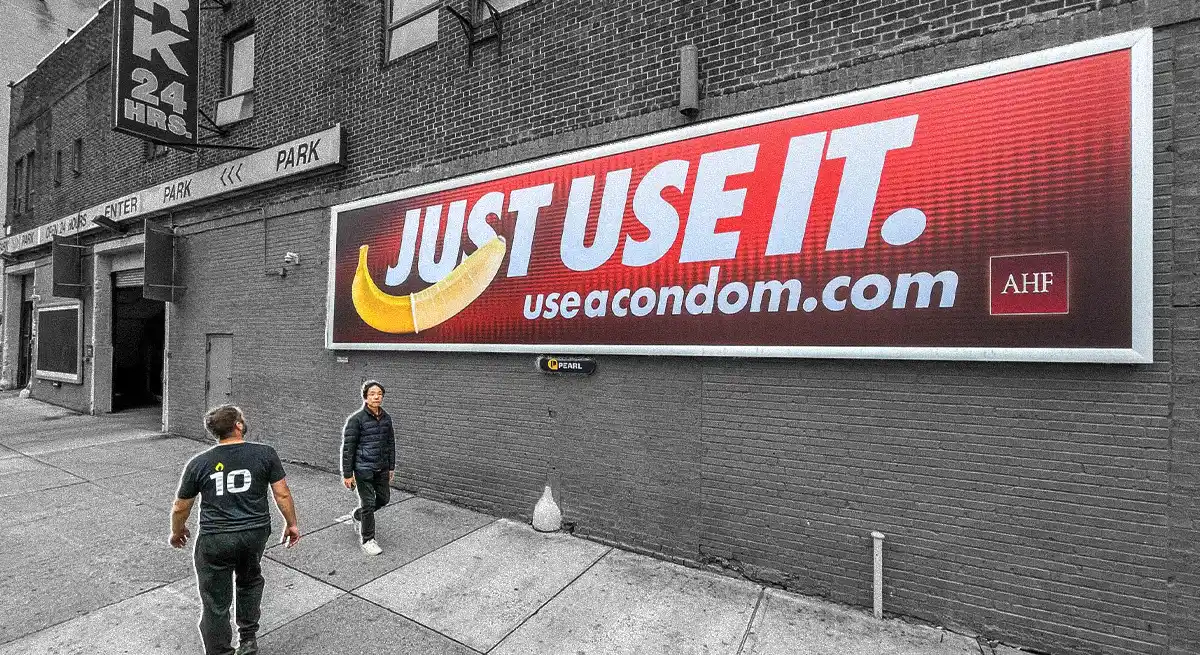
Getting attention in public spaces means designing for the physical constraints of the medium first. AHF's approach centers on a strict editorial discipline that limits how much information any single billboard tries to convey, with the visual template guided by a strict word count rule and a main image doing the heavy lifting. The discipline also shapes how the organization uses disruptive tactics, with installations like 48-foot wide condoms in public spaces designed to grab attention without losing the core message. "We've developed an approach to creating our artwork that has really been broken down to a science," Farmer explains. "We'll have a main image that draws your eye, taking up the majority of the billboard, and we try to keep the copy to less than four words. If we can get it down to one word, which we've done before, that's even better."
The editorial discipline shows up most clearly in how AHF designs for reflection over directive, since the audience receiving the message is often the audience least responsive to public callouts. An example is a companion pair of billboards in a campaign that asks "Cheating?" alongside a prompt to use a condom, followed by a second board asking "Cheated on?" and directing viewers to get a free STI test, with the paired questions designed to land as personal prompts rather than public lectures. "We don't want people to think we're sex shamers," Farmer says. "We find companion pieces to get the message across and ask people questions so they think about it themselves, instead of us pointing the finger and saying, 'When was the last time you got tested?' That doesn't work. We definitely know that."
Recognition through repetition
Two decades of disciplined repetition have made AHF's visual template instantly recognizable as a global institutional brand. The placement strategy reinforces the recognition by appealing to specific neighborhoods where target demographics live, with the goal of making sure residents feel culturally understood by the organization showing up in their environment. The repetition pays off in brand familiarity that earlier campaigns never enjoyed. "Outdoor is still the most important component for our branding," Farmer says. "We really want people to know who we are. In the past, no one would know who AHF was unless they were an insider involved in HIV/AIDS. Now people see our work and say, oh, that's an AHF billboard."
The trade-off is that AHF's leadership accepts an imperfect attribution loop, since the people walking into care from a billboard rarely fit the clean digital tracking patterns most marketers are accustomed to measuring. Farmer points to the social media spillover as one of the clearest indicators that the work is landing, with Reddit threads and other online conversations giving the team a window into how physical billboards become digital discussion. "It is so hard to really figure out who is being funneled from seeing your outdoor because there are so many ways they could come into our care," Farmer notes. "Even if they say the website, they might have seen the website on a billboard first because that's where we advertise the viewer to go to get more information about us and our services."
Community-first by design
For marketers considering OOH, the bigger discipline shift is treating physical media as the start of a journey rather than the proof of one. Effective campaigns work because they meet people in the community first and route them toward whatever channel will close the loop, whether that is a search, a website, a social conversation, or a phone call. The placement, the language, and the design all have to be calibrated for the specific community in front of the board. "Start small and come up with something that's really intriguing to get people's attention," Farmer advises. "Don't use eight words and tiny typefaces that people can't read. You don't have to be overly shocking. Sometimes it's just clever messaging or something that makes them think."
The deeper lesson is that the best outdoor work creates space for a private decision in a public moment. For AHF, the goal of a billboard is to safely initiate a conversation that a vulnerable person can finish on their own terms, with tight discipline, concise copy, and intentional community placement doing the work of moving people from public encounter to private next step. The medium succeeds when it gives people permission to start the journey without requiring them to opt in or self-identify first. "Learn about your community first. Place your billboards in the right places, with the right messaging, and in the right languages," Farmer concludes. "You don't have to explain everything or give it all away on the billboard. That's what your website is for. The outdoor ad is just your entry point to get them to take the next step."