Team One's Modern Take On The Soccer Boot Makes The Case For Human-Considered Craft
Chris Graves, Chief Creative Officer at Team One, walks through how ART1FACT LABS uses single physical objects to make the case for human-considered work at every price point
Make brandbeat one of your go-to sources on Google

The digital tools are going to allow you to make hundreds of things that you could ordinarily have made only one or two of. But it doesn’t mean they’re going to be better. It just means you’re going to make more.

Chris Graves
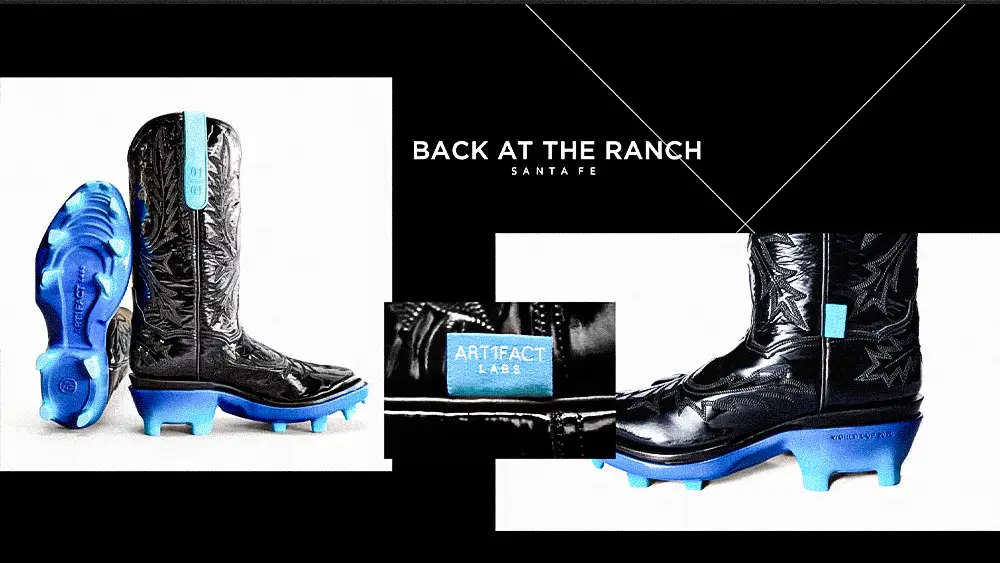
Cowboy boots and soccer cleats sit at opposite ends of the sports footwear market. In the lead-up to the World Cup arriving in the U.S., one advertising agency chose to build a single physical hybrid of the two, fusing Dallas iconography with global sports culture in one object. The artifact arrived at a moment when most of the industry's attention has been going to generative AI and infinite digital scale, and it makes the counter-argument by simply existing: a tangible object that stops people, invites the question, and moves the conversation without a screen doing any of the work.
Chris Graves is the Chief Creative Officer at Team One, a role he has held for 23 years after working as a Creative Director at TBWA\Chiat\Day. He specializes in aspirational brands and luxury products, and brings ArtCenter College of Design training to work whose value depends on the visibility of human craft. His argument is that the cowboy boot project is a deliberate demonstration of what human touch can do for a brand in an era of mass digital production. Graves keeps that argument tied to personal practice: he takes an annual two-week retreat in Maine to build furniture by hand with no machines involved.
"The digital tools are going to allow you to make hundreds of things that you could ordinarily have made only one or two of, but it doesn't mean they're going to be better. It just means you're going to make more," says Graves. “Most luxury brands have to maintain the aura of a luxury product while selling hundreds of thousands a year. The same volume that makes the commercial case can undercut the perception the brand is built on. "The ease with which you can produce massive things at scale makes it even more special to do something that's rare and singular," he adds.
The 1-of-1 discipline
Team One's practical answer to the argument is ART1FACT LABS, an internal program Graves set up as a skunk works tasking Team One’s Design Director, Ryan DiDonato, and the creative team with craft-heavy physical work. The lab moves creatives, strategists, and web developers off their screens and into direct contact with physical fabrication as the medium. Its outputs have moved through custom skis, surfboards, and now the World Cup boots, each bound by a hard 1-of-1 rule that the agency has to enforce against manufacturing partners who assume the request is a starting order and keep verifying that only one unit is what the agency wants.
The cultural collision built into each object is what carries the discussion. The World Cup boots draw on a naming difference between the U.S. and the rest of the world that most Americans have never thought about. The physical hybrid puts that gap in front of them as an object they cannot look at once and put down. "The rest of the world refers to the shoes as football boots, and only in America do we not call them boots," Graves explains. "It's two worlds colliding: the World Cup and American football, not soccer. There's a little bit of an absurdity to this and a little bit of a wink."
The material work of building the objects happens through direct partnerships with independent makers, including the family behind Back at the Ranch, the women-founded Texas based bookmaker that reflected the same commitment to craftsmanship that defines every ART1FACT LABS partnership. "ART1FACT LABS gives us the opportunity to explore those intersections through one-of-one pieces that celebrate the people and traditions behind them,” said DiDonato. The arrangement operates more like an apprenticeship, and it gives Team One access to a category of practitioner most agencies now interact with only at the finished-product level. Graves argues the exposure changes what his team considers standard practice, in a category where the production processes agencies default to have historically optimized craft and time out of the workflow. "I want our teams to work with people who make things, who are experts at it, and who've done it for a long time," he says. "We pick up some of those values and tendencies they already have."
From ateliers to sandwich shops
For Graves, the discipline behind ART1FACT LABS isn't restricted to the luxury tier where the lab currently operates. He extends the principle to every price point, and the specific brands that occupy consumers' attention over long periods tend to reflect the decisions of people paying attention to other people. "No matter what strata your brand operates in, whether it's luxury or mass or everyday objects, the things that resonate aren't just human-made, but human-considered," Graves says. "Don't let the machines drive those choices. Be tuned to and anticipate what humans need at any price point."
The pattern is easiest to see in the smallest businesses, where nothing else is doing the work of holding a customer. Graves illustrates the point with a specific business he uses regularly and knows well, in a category where budget for marketing isn't what drives customer loyalty. "It's a user experience mentality. The sandwich shop around the corner that I love, they think about the customer and they understand them," he concludes. "You can get distracted by all the machine antics, but behind it all is still going to be a human consumer."